


Digging Under Grizzly Graves: 2025 Yellowstone Bear Deaths Break Record: Louisa Willcox

Updated: Aug 12

According to the Interagency Grizzly Bear Study Team (IGBST), which serves as the official government repository for information on dead grizzlies in the Greater Yellowstone Ecosystem (GYE), 73 Greater Yellowstone grizzly bears are dead, most by human hands — breaking the all-time record set in 2024 of 72.
 Source: IGBST provisional dead bear database, as summarized in this article. |
The current death rate is unsustainably high and threatens to reverse the hard-fought progress towards recovery over the last fifty years. Programs to address the causes of grizzly bear deaths and promote coexistence are laudable but far from adequate. Poaching is on the rise, as are deaths from vehicle strikes. Since the climate-driven collapse of whitebark pine forests, grizzly bears have been seeking more meat to compensate for the loss of high-fat whitebark pine seeds, with disastrous results. This is why livestock and hunter-related conflicts are among the top causes of grizzly bear deaths in 2025 — and for the last fifteen years.
But you won't hear these facts from government officials responsible for grizzly bear recovery. Nor will you hear the relevant context, summarized below. Managers are mum not only about the severity of the mortality problem, but also about practical ways to address it, discussed in the Recommendations section at the end of this blog.
Further deepening the darkness, managers canceled the 2025 fall interagency grizzly bear meetings, where important scientific, conflict, and other information is typically shared, with no explanation. At the spring 2026 meeting, managers dodged important topics, including the next delisting rule.
Instead, many leaders have been lashing out at the US Fish and Wildlife Service (FWS) over Director Brian Nesvik's December 2025 announcement that the agency's decision to strip protections under the Endangered Species Act (ESA), which would allow the killing of many more grizzlies, has been delayed by two years. Wyoming Game and Fish Department Director Angi Bruce said this: “This decision is unfortunate and disappointing for grizzly bears and for the people of Wyoming.”
Rather than speculate on bears' disappointment at not being killed, I return to the seriousness of the government's silence about excessive grizzly bear deaths. This violates the spirit of the Public Trust Doctrine and the ESA, which requires the government to manage endangered species as a public trust for current and future generations and to prioritize the public good over private gain.
Much has been written about the government's duty to protect the public trust in the context of wildlife and endangered species recovery, including core principles of transparency and accountability to protect the broader public good, rather than special interests. (Predators and the Public Trust, by Adrian Treves et al. 2015, is particularly insightful on the topic.)
Unfortunately, secrecy has long plagued grizzly bear research and management. My late husband, pre-eminent grizzly bear expert Dr. David Mattson, wrote extensively and passionately about the problem. As a federal scientist, he paid a personal price for his commitment to transparency and for speaking truth to power.
David emphasized that, in government, the scientific debate is shaped by echo chambers, as well as by shared cultural norms, values, and educational backgrounds among officials that reinforce a sense of ingroups dominated by pro-industry, pro-delisting proponents, at the expense of outgroups: independent-minded experts like David, and environmentalists like me.
As discussed in more detail below, these factors help explain why government scientists fail to use evidence emerging from their own data when it might inconvenience special interests or cast doubt on the delisting agenda. They also explain why David was seen as such a threat: he understood the strengths and weaknesses of the government's science and, for 35 years, worked successfully with environmental litigators to make it relevant to protecting grizzlies.
Who will step in now?
But First: There Are More Grizzly Graves than Advertised
IGBST's provisional dead bear database underrepresents the actual dead. Reasons include the following.
1. The actual body count is closer to 148 individuals, constituting an alarming 15% of the population.
Experts estimate that roughly one unreported or unknown bear is killed for every bear death listed as “known” or “probable” on the IGBST database. While the IGBST will address this issue when the 2025 annual report is released, that will not happen for another year and a half or so. Meanwhile, 148 deaths is a scientifically defensible ballpark.
Using the IGBST's 2024 total population estimate of 1,030–1,050 bears, this means that about 15% of the population died in 2025. This far exceeds the worldwide consensus among bear experts on a sustainable mortality rate: 10%, at most.
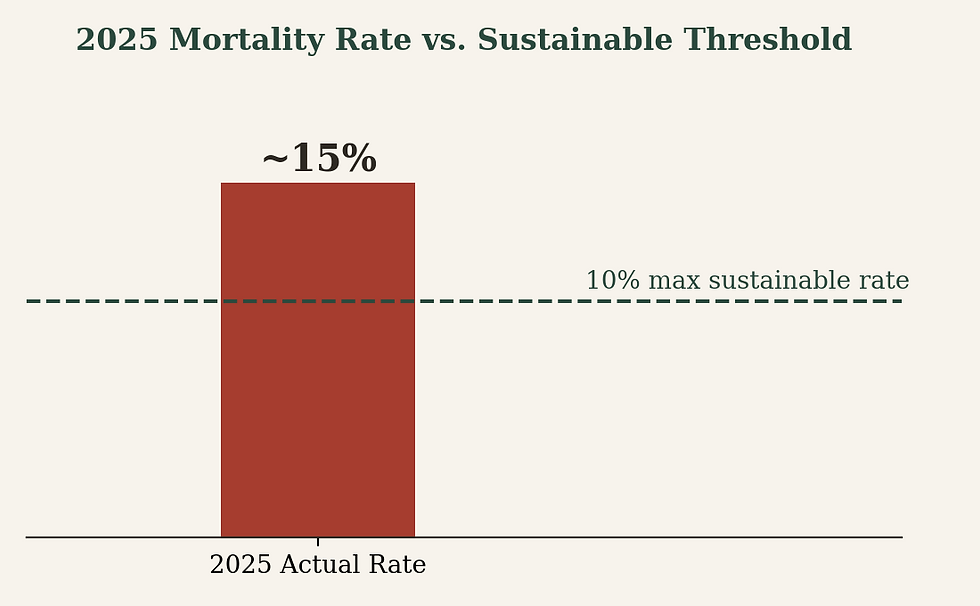 Based on ~148 estimated deaths against IGBST's 2024 population estimate of 1,030–1,050 bears. |
2. Because of flawed IGBST methods, the dead bear problem is worse than widely understood.
David Mattson worked for decades for the IGBST and found much of its work to be flawed, hence his report, Flawed Science. He identified problematic biases affecting estimates of mortality and concluded that IGBST methods tend to underestimate unreported dead-bear counts by approximately 3-fold (p. 45–47, Flawed Science).
This means that over 200 grizzlies could be dead this year.
 “200+” bar shown at representative height; Mattson's Flawed Science finds IGBST methods underestimate unreported deaths ~3-fold. |
Breakdown of Leading Causes of 2025 Grizzly Bear Deaths
The following summary presents the top four causes of grizzly bear deaths, along with my comments based on long experience in this arena. While there are different ways to parse the categories, I relied on IGBST leader Matt Gould, who knows the dead bear data best, for guidance on the framework of my breakdown below.
 “Other/Unspecified” (16) is the remainder of the 73 total after the four itemized causes discussed in the text — not a category IGBST reports separately. |
1. Livestock-Related
By far the leading cause of death, accounting for 21 grizzlies, stems from conflicts with livestock, mostly on public lands. (One related to pigs and two to alpacas, but the rest were cattle-related.)
Over the last two years, we have seen a spike in livestock-related deaths: 21 in 2025 and 31 in 2024, compared to 12 killed in 2023 and 6 in 2022 (compared to virtually none before 2008).
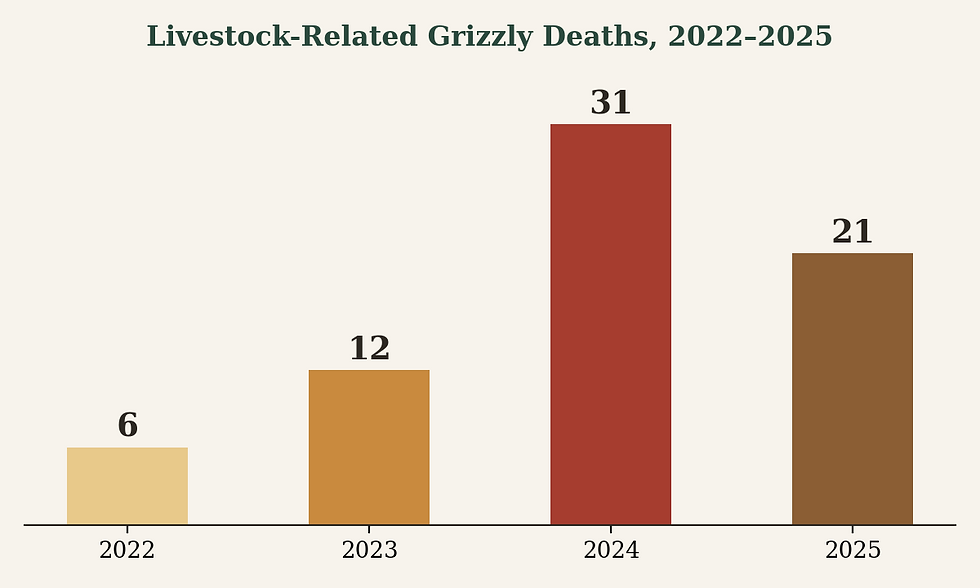 Virtually no livestock-related deaths were recorded before 2008. |
What is going on here? In 2025, the Fish and Wildlife Service released a draft revision of the 4(d) rule under the Endangered Species Act that would facilitate killing grizzlies that mix it up with cows on public lands. Have practices changed even though the policy is not yet final?
IGBST annual reports show hotspots for cattle conflicts, such as the Upper Green and Owl Creek in Wyoming, as well as significant areas where cattle and grizzlies mingle with few incidents. The peaceful landscapes tend to reflect the operators' commitment to coexist with bears and to deploy commonsense practices, such as range riders and electric fences around calving areas, as well as more amenable ecological factors.
The biggest hotspots, such as the Upper Green, tend to reflect a lack of commitment and effort by operators (typically very wealthy) to coexist, their willingness to use their political connections to bully the Forest Service, and cowardice among public lands managers. David and I felt enormous empathy for the brave biologists on the Bridger-Teton Forest who paid a significant price for standing up for the broader public and grizzlies. Fearing political backlash, their bosses not only refused to ask for the bare minimum — requiring that the permittees and employees carry bear spray — but also increased the number of bears that could be killed.
David played a major role in the litigation that overturned this move.
🎳 “This aggression will not stand, man.” — The Dude, The Big Lebowski |
2. Food Conditioning
Food-conditioning of grizzly bears accounts for 16 grizzlies killed by managers. It should be noted that almost no food-conditioned grizzlies are killed in Grand Teton and Yellowstone parks: indeed, the parks set the gold standard for coexistence.
Most food conditioning of grizzlies occurs on private lands, where sanitation successes abound in some areas, but where human attractants are widely available in others. David and I have written about success stories, and the challenges and contingencies associated with coexistence.
These deaths occur for various reasons, including inadequate sanitation infrastructure; weak regulations, education, and/or enforcement efforts; clueless people in grizzly country; bad attitudes, and carelessness. Climate-driven changes in native foods, forcing bears to forage closer to people, also contribute.
The bottom line: if there is a weakness in the system, including at the level of personal behavior, a grizzly bear will find a way to exploit it.
3. “Under Investigation” for Possible Poaching, and Hunter-Related Conflicts
So far, eleven cases are “under investigation” for possible poaching. While only one death is officially attributed to hunters (a case involving a black bear hunter mistaking a grizzly for a black bear), these “under-investigation” cases typically involve grizzlies killed by big game hunters and/or claims of Defense of Life and Property, which are legal exemptions under the ESA.
In a powerful 2023 article in The Intercept, investigative journalists Ryan Devereaux and Jimmy Tobias show that poaching is on the rise and that law enforcement is sorely lacking, partly due to officials' hostility or indifference toward grizzlies.
According to the authors, former FWS agent Steve Stoinski, based in Wyoming, said “...the way some people operate — shoot these bears, shovel, and shut up about it.” One Interior Department official, who requested anonymity to speak candidly, said, “...[Grizzlies] might as well be delisted right now with how we're acting.”
Here is an example. In 2013, a hunter and camp worker returned to the place in the Shoshone Forest where the hunter had killed an elk a few hours earlier to find that a grizzly bear had dragged it 150 yards into the trees, and a sow with cubs and two other male grizzlies were nearby. Instead of leaving, the men fired multiple rounds, threw rocks, and yelled to scare the bears off, and dressed out the elk. Their bear spray remained in a pack by the horses as the five bears remained nearby. When a grizzly approached the carcass, the men shot and killed it with revolvers. The men claimed self-defense, which is legal under the ESA. A Wyoming attorney bought their argument and did not prosecute the case.
🎳 “Sooner or later, you are going to have to face the fact that you're a moron.” — The Dude |
Poaching is especially egregious given that grizzlies are protected under the Endangered Species Act. By prosecuting only a tiny fraction of malicious killings, the government gives potential poachers a green light. And, because the details of the vast majority of cases listed “under investigation” are kept under wraps, the public has no clue about the depth of the problem.
For an interesting perspective on the problem of poaching, see my interview with the late Sam Jojola, a former FWS undercover agent extraordinaire.
4. Vehicle Strikes
Vehicle strikes account for nine grizzly bear deaths, a record for the GYE. The IGBST database provides scant details, including locations.
These deaths almost certainly track the increase in traffic, consistent with near-record park visitation this year. Clearly, more work is needed to make road crossings safer for bears — and people.
Examples of effective wildlife crossing structures abound in Europe and Canada. The Salish Kootenai Tribe is responsible for the best example in the lower 48 of a system of wildlife-friendly crossing structures along the Highway 93 corridor between Missoula and Kalispell.
Related Problems: Transparency and the Public Trust, (More) Flawed Science, and Climate-Driven Changes in Foraging Behavior
1. Transparency and the Public Trust
The longstanding lack of transparency in the grizzly bear research arena has undermined the public trust and harmed grizzly recovery efforts. David identifies two root problems.
“Perpetuation of a Data Monopoly: The production of reliable science requires transparency and opportunities for multiple independent researchers to test and potentially replicate research results. This especially holds true for topics that spawn controversy, as does grizzly bear management. There is only one GYE grizzly bear population, and a single data set was collected at public expense by government employees. Under such circumstances, there is no justification for IGBST researchers aggressively perpetuating a data monopoly, as they have done for the past 30+ years. This monopoly has debarred any opportunity for correctives offered by ideals of scientific practice and ample scope to produce the flawed science described in this report.” David Mattson, Flawed Science, Section 6.3 |
This problem is compounded by:
“Corruptive Financial and Political Influences: Research agendas of IGBST scientists were fundamentally shaped by personal and monetary influences exerted by the USFWS and exacerbated by financial dependencies created by a parent agency operating under a business model of research production. IGBST researchers existed, moreover, in a politically over-heated authoritative environment dominated by regional elected officials and appointed agency leaders who used a biased selection of unreliable information to promote removal of ESA protections for GYE grizzly bears.” David Mattson, Flawed Science, Section 6.2 |
The upshot is that states and special interests have long dominated the research and management agenda — and worked to keep the broader public in the dark. And because of the focus on promoting delisting, government research programs have neglected vital research on the impacts of climate change on food habitats, distribution, and demography; on exploding human population growth and recreation; and on long-term isolation and the prospects of connectivity.
David's critique also explains why scientists in IGBST and other agencies routinely fail to correct officials when they spout nonsense, as when Congresswoman Harriet Hageman claimed in 2025 that 200 grizzlies are born annually in the GYE.
By failing to defend their work and tacitly greenlighting misinformation, the IGBST and others fuel unnecessary controversy. Not accidentally, environmentalists committed to science, transparency, and the truth often wind up looking like bad guys.
2. More Flawed Science
Claims about an exploding population notwithstanding, IGBST data show that the Yellowstone population has flatlined over the past 20 years, no matter which of the two major counting methods is used.
Importantly, David finds that government methods for estimating population size and trends remain fundamentally flawed. This casts doubt on the IGBST's population size and trend estimates over the past 20 years.
“The IGBST used a trend metric that was biased by search effort and bear sightabilities (i.e., unduplicated females with Cubs of the Year) together with implausibly low estimates of bear death rates to derive estimates of population size and trajectory for GYE grizzly bears. The resulting dubious estimates were likely inflated, with this bias compounded by failure of IGBST researchers to account for reduced reproductive output of older female bears (i.e., senescence). This concatenation of problems calls into question all estimates of population size and trend produced by the IGBST during the past 20 years.” David Mattson, Flawed Science, Section 4.6, p. iii and pp. 40–42 |
Why does IGBST refuse to address these problems? Could the agency, and/or government funders of its work, fear that doing so could cast doubt on their delisting agenda and related plans to reduce grizzly bear numbers, including by trophy hunting?
And do government scientists really believe that an eighty-year-old female (in bear years) reproduces at the same rate as a twenty-year-old?
The IGBST also argues that “density-dependent” dynamics (analogized to fitting just so many sardines in a can) explain why grizzly bears are spreading out and more are being killed. David responds with this:
“When adjusted for an expanding distribution, population-averaged bear densities did not appreciably change during 1990–2022 and were in fact lowest at a time that conflicted with when the IGBST claimed densities were highest.” David Mattson, Flawed Science, p. iv |
3. Climate-Driven Changes in Foraging Behavior
David Mattson explains the increase in grizzly bear deaths over the last 15 years this way:
“As a bottom line, rapid increases in total known and probable grizzly bear deaths in the Yellowstone ecosystem post-2010 are correlated with terminal declines in availability of whitebark pine seeds. Taken together, these meat-related increases in mortality constitute compelling evidence for deleterious population-level effects arising from loss of whitebark pine as well as cutthroat trout, with additional foreseeable negative effects. Inattention to meat-related mortality in IGBST publications during the last two decades constitutes yet another important failing in analyses by Van Manen et al. (2016, 2023a) and casts further doubt on conclusions in these publications regarding putative effects of conspecific density.” David Mattson, Flawed Science, p. 35 |
David goes further:
“The consequences of losing native foods located in secure environments and related compensatory increases in exploitation of anthropogenic meat were manifest in a quadrupling of known or likely grizzly bear mortalities. This sharp increase in bear deaths closely followed terminal losses of whitebark pine trees to a mountain pine beetle outbreak and was typified by a near doubling of the proportion of deaths caused by conflicts with elk hunters or retaliations for depredation on livestock. Mortalities simultaneously doubled as a fraction of total estimated population size, suggesting a commensurate increase in grizzly bear mortality rates. Even more consequential, the fraction of female versus male bears killed because of depredation conflicts also more than doubled.” David Mattson, Flawed Science, Sections 3.10–3.12 |
A Better Way
Improving coexistence seems simple at one level, but it is functionally complicated on the ground. It requires an understanding of: bears and bear behavior, and how, when, and why they use particular landscapes; human values and attitudes; the social, cultural, economic, political, and regulatory context; relevant institutions, including agencies, nonprofits, and industry groups, and how they make decisions, their incentives and disincentives, norms and culture, leadership, and capacity.
Despite the complexities, a few recommendations emerge from this discussion.
1. Improve Transparency “I'll tell you what I'm blathering about... I've got information, man! New s*** has come to light!” — The Dude A. Release the Damn Data. The monopoly on the data is not serving grizzlies or the broader public interest. Just release it. This data was collected with taxpayer dollars, and taxpayers deserve the best scientific understanding about the population to make informed choices that ensure that grizzlies flourish. Smart graduate students worldwide would seize the opportunity to take a fresh look at this world-class dataset. We all might learn something. B. Establish an Independent Panel of Experts to examine the dead bear data, improve our understanding of the dynamics driving conflicts and deaths, and make recommendations. “This is a very complicated case, Maude. You know, a lotta ins, a lotta outs, a lotta what-have-yous.” — The Dude We need to know more about how and why grizzly bears are being killed, especially after the collapse of whitebark pine when grizzlies shifted to eating more meat, to inform efforts inside and outside government to reduce deaths. Because of political pressure to delist grizzly bears and the government's chronic failure to conduct comprehensive and helpful analyses, an independent body of experts should be established. A comprehensive understanding of the details and dynamics driving conflicts related to hunters and livestock operators is particularly important. Given the outsized influence of these interests across all aspects of grizzly bear management, independent experts are essential at this juncture. Case studies of successful conflict resolution efforts should also be pursued. |
2. Redouble Efforts to Solve Problems Instead of capitulating to special interests, managers must roll up their sleeves and tackle these problems in meaningful ways. This means setting expectations that the status quo and current levels of killing are not acceptable. Because of managers' failures to address the mounting livestock and hunter-related deaths, outside leadership and expertise in problem orientation and problem-solving will be necessary. Appendices in the Conservation Strategy have some good ideas, but they have never been sorted or implemented. A. Bear Pepper Spray: Not Brains in a Can, But... All parties permitted to operate on public lands in grizzly bear habitat must be required to carry and know how to use bear pepper spray. The Forest Service already requires permittees, including livestock operators, hunting outfitters, and others, to comply with bear sanitation rules. |
3. Tackle the Problem of Poaching As required by law, the government must aggressively tackle the problem of grizzly bear poaching. For starters, they need to devote more resources to sustain dedicated agents like Sam Jojola as well as government prosecutors to enforce poaching laws. In addition, all documents related to cases under investigation must be publicly released after the cases are resolved. The public deserves to know how well our laws are being enforced. |
4. Improve Ways to Engage the Public Establish a Citizen Working Group to Address Primary Causes of Grizzly Bear Deaths. Several years ago, the Yellowstone Ecosystem Subcommittee (YES) disbanded a collaborative citizen working group to reduce bear conflicts, claiming they had nothing further to discuss. What? It should be clear that all hands are needed on deck. The government alone cannot fix this problem. |
5. Set Up an Early Warning System for Poor Food Years YES should set up an early warning system triggered during poor food years and/or when grizzly bear deaths reach concerning levels over the summer months, to alert landowners, visitors, and citizens to be especially careful in grizzly country. While managers and non-profits have recommended such a system for decades, it has yet to become a reality. Non-profits, businesses, and others would undoubtedly help with social media and outreach efforts targeting specific user groups. |
6. Make Highways and Roads Safer for Grizzlies David's report Roads, Residences, and Grizzly Bears: Effects of Human Infrastructure on Brown and Grizzly Bears is the most comprehensive on the topic and contains numerous recommendations. Much can be done to make roads and highways safer for bears, including signage, prompt carcass cleanup, and lowering of speed limits along roads with high bear use, such as in Grand Teton Park, where grizzlies have been killed by vehicles. |
7. Develop an Interagency Plan to Protect the Grizzly Bears of Jackson Hole Because of their tolerance for people, the celebrity grizzlies of Jackson Hole are especially vulnerable. Grizzlies continue to be killed because of food conditioning and accidents that can be avoided. For example, grizzly matron 399 was struck by a vehicle in 2024 while eating game left along Highway 89 in Snake River Canyon. |

Given the enormous public interest in the fate of these grizzlies, agencies must step up their game. Because of the enormous complexity of the issues facing Jackson area bears, I will discuss some approaches in an upcoming blog post.
Saving Yellowstone Grizzlies Is Not Rocket Science
With the lowest reproductive rate of any land mammal in North America, Yellowstone grizzlies cannot withstand current rates of killing. Meanwhile, threats are mounting from climate-driven losses of key bear foods, an influx of people into and around grizzly bear habitat, related recreation pressures on public lands, and long-term genetic isolation.
At the same time, funding for FWS, IGBST, the Forest Service, and the Park Service for grizzly recovery efforts, such as law enforcement and on-the-ground monitoring, has shrunk to alarming lows. Massive DOGE-related budget cuts add insult to injury, with grizzly bear agencies reporting cuts of 10–20%.
 |
Grizzly 615: Photo Credit Gary Schocky |
In mining decades-old memos that David and I had written about the dead bear problem, invariably during the holiday season, I found many versions of this simple message: We humans, who govern the fate of our last grizzlies, the last 5% of a unique genetic lineage of grizzlies, Clade 4, continue to kill too many grizzlies for avoidable and often dumb reasons. Worse, in service of a political agenda to strip federal protections, kill even more bears, and exploit their habitat, the government toggles between silence and spinning the science to keep the public ill-informed and divided.
Despite its power, the grizzly bear is no match for modern civilization. The Great Bear faces unprecedented threats, including climate change, human population growth, and related pressures on public lands, as well as the renewal of destructive habitat policies and the gutting of protections by federal agencies.
Now more than ever, we must demand better for bears — and all of us.
Take Action: Read David Mattson's full Flawed Science report, and share your own reasons for caring about the Great Bear (artwork, poems, perspectives) by emailing info@grizzlytimes.org for possible posting on Grizzly Times. |
Grizzly Times · grizzlytimes.org


